
Kitchen lighting does more than brighten a room. It affects how comfortably you cook, prepare food, clean, entertain, and move through the space. No matter how gorgeous your cabinetry and counter tops, your kitchen can still feel undesirable if your lighting is insufficient, overly bright, misdirected, or on and off with a switch.
When you decide to upgrade the lighting in the kitchen, look beyond the fixtures. Great lighting design involves the whole room and requires understanding the room’s shape, ceiling height, natural lighting, work zones, finishes, and daily activity.
Whether you are planning a few lighting improvements or including kitchen remodel lighting in a larger renovation, these 11 considerations can help you create a brighter and more functional kitchen.
Assess What Your Current Kitchen Lighting Is Missing
Before replacing fixtures, take a close look at how your kitchen works after dark.
Do you struggle to see while chopping vegetables? Does your counter top sit in a shadow? Is the area around the sink too dark? Does the kitchen feel excessively bright when every light is switched on? These observations can reveal more than simply deciding that your fixtures look outdated.
Walk through your normal evening routine and identify areas that need improvement.
Your current kitchen may be missing:
- Adequate task lighting
- Better illumination over counter tops
- Lighting inside or beneath cabinets
- Proper illumination around the kitchen island
- Ambient lighting for the entire room
- Accent lighting for decorative features
- Separate controls for different areas
Understanding the problem first makes it easier to choose the right kitchen lighting upgrade ideas instead of adding fixtures without a clear purpose.
Plan for Three Layers of Kitchen Lighting
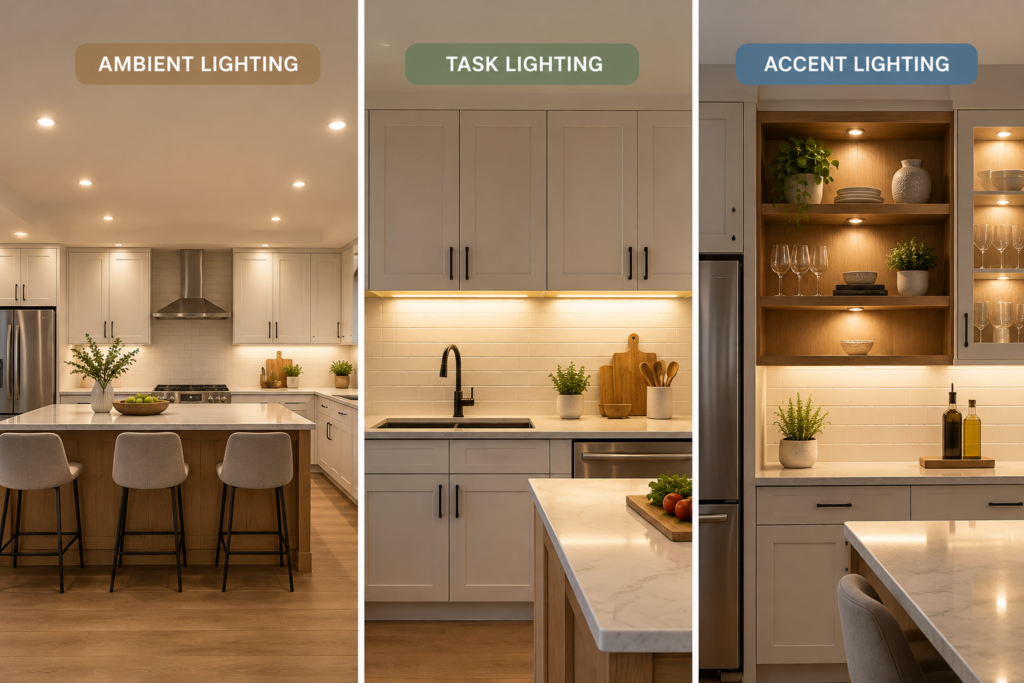
A well-designed kitchen usually benefits from more than one type of lighting. Instead of relying on a single ceiling fixture, consider three basic layers.
- Ambient lighting provides general illumination throughout the room. Recessed fixtures, flush-mount lights, or appropriately positioned ceiling fixtures can contribute to this layer.
- Task lighting focuses on areas where you perform activities that require better visibility, such as food preparation, cooking, washing dishes, or reading recipes.
- Accent lighting adds visual interest and can highlight architectural or decorative features, such as cabinetry, shelving, artwork, or a back-splash.
Combining these layers is an important part of effective kitchen lighting design. You can use one layer when you need focused illumination and combine several when the entire room needs to feel brighter.
Identify the Kitchen Areas That Need Task Lighting
Task lighting should follow the way you use your kitchen.
Look at your counter tops, sink, cook-top, island, pantry, and other work areas. If overhead fixtures are positioned behind you while you work, your body can cast shadows directly onto the surface.
Under-cabinet lighting can be especially useful for counter tops because it brings light closer to the work surface. Pendant lights or appropriately positioned fixtures can provide additional illumination over an island or peninsula.
Think about your most frequently used areas rather than simply placing lights at equal distances around the room.
For example, a counter top primarily used for food preparation may need stronger task illumination than a less frequently used corner.
Good kitchen lighting placement should make everyday activities easier without creating glare or unnecessary brightness.
Choose the Right Kitchen Lighting Fixtures for Each Area
Different fixtures serve different purposes, so avoid choosing every light based solely on appearance.
Depending on your kitchen design, you might consider:
- Recessed lights for general illumination
- Pendant lights over an island or peninsula.
- Under-cabinet lights for counter tops
- Toe-kick lighting for subtle accent illumination
- Track lighting for flexible directional lighting
- Flush or semi-flush fixtures for kitchens with suitable ceiling layouts
- Decorative fixtures to create a focal point
Your fixture selection should also account for the size and proportions of the room.
For example, oversized pendants may overwhelm a compact kitchen, while very small fixtures may look lost over a large island.
During a renovation, coordinate fixture locations with cabinets, appliances, ceiling features, and other elements before installation begins.
Get the Brightness and Color Temperature Right
Brightness counts, but picking the brightest bulb you can find isn’t the solution. Some kitchen spaces demand more light than others. For example, task areas should be well-lit to work in, while ambient lighting should be bright enough to move comfortably.
Then there is kitchen lighting color temperature.
Color temperature affects how warm or cool the light appears. Warm light can create a comfortable, inviting atmosphere, while cooler light can provide a crisper appearance.
In a lot of kitchens, a neutral to warm white range of colors will be a good compromise between function and comfort. The right color for you will depend on what finishes you have, the amount of natural light, and the feel you want to create.
Also consider color rendering. Lighting that accurately shows colors can make it easier to distinguish food, ingredients, and finishes.
Consider Your Kitchen Layout, Ceiling Height, and Natural Light
Lighting should be designed around the room – not added independently of it.
A long kitchen may need a different lighting arrangement from a square kitchen. A kitchen with a high ceiling may require different fixtures and positioning than one with a standard-height ceiling.
Also pay attention to natural light in the kitchen.
Check the amount of daylight that comes into the room and the variation it has during the day. For example, if your kitchen has large windows or glass doors, then this area will require less light than a more open-plan interior kitchen.
Consider:
- Ceiling height
- Cabinet placement
- Window locations
- Doorways
- Kitchen island position
- Appliance locations
- Open versus enclosed layouts.
- Areas that become naturally shadowed
The goal is to supplement natural light rather than simply compete with it.
Decide Where You Need Dimmers and Separate Controls
A kitchen does not always need the same lighting throughout the day.
Bright task lighting may be useful while preparing dinner, but you may prefer softer illumination while having a meal or entertaining guests.
Dimmers can help adjust the intensity according to the activity and time of day. Separate controls are equally useful because they allow you to operate different lighting layers independently.
For example, you could have separate controls for:
- General ceiling lighting
- Under-cabinet lighting
- Island pendants
- Accent lighting
- Dining or adjacent areas
This gives you more flexibility than connecting every fixture to one switch.
When planning kitchen lighting installation, discuss switch and control locations early so electrical work can be coordinated with the rest of the kitchen.
Match Your Lighting to Your Kitchen’s Style and Finishes
Lighting fixtures are part of your kitchen’s visual design.
Your choices should complement your cabinets, counter tops, hardware, back splash, flooring, and other finishes.
A modern kitchen could be designed for flush fittings, straightforward pendants, or minimal ornament, whereas a more traditional kitchen could allow fittings with traditional forms or lighting with warmer finishes.
You do not necessarily need every metal finish to be identical, but the lighting should feel intentional alongside the other hardware.
Also consider the light itself. The color and direction of illumination can influence how cabinets, counter tops, back splash materials, and wall colors appear.
This is particularly important when planning modern kitchen lighting, where simple fixtures often become part of the overall design rather than merely serving a functional role.
Think About Energy Efficiency and Smart Lighting Features
Lighting upgrades can also be an opportunity to improve energy efficiency.
LED kitchen lighting is a popular option because LED fixtures and bulbs can provide efficient illumination and are available in a wide variety of styles, brightness levels, and color temperatures.
Think about your options. Beyond the look of a fixture, ask about energy consumption, lifespan, maintenance, and access to replacement bulbs or integrated parts.
You can also explore smart kitchen lighting if it fits your household and budget.
Depending on the system, smart lighting may allow you to control fixtures through an app, voice commands, schedules, or automated settings.
Smart features are not essential for every kitchen, but they can provide additional convenience when integrated thoughtfully.
Set a Budget and Decide Between DIY and Professional Installation
Before purchasing fixtures, establish a lighting budget that includes more than the cost of the products.
Your overall cost may include:
- Light fixtures
- Bulbs or integrated LED components
- Switches and dimmers
- Wiring or electrical modifications
- Installation
- Ceiling repairs or finishing
- Smart controls
- Additional materials
Some lighting changes may be relatively straightforward, while others can involve new wiring, ceiling modifications, electrical connections, or changes to existing circuits.
If the project involves electrical work or significant changes to your kitchen’s lighting system, professional installation can help ensure the work is appropriately planned and completed.
For a larger remodel, coordinate the lighting plan with the rest of the renovation instead of treating it as a final-stage addition.
Avoid These Common Kitchen Lighting Mistakes
Even attractive fixtures can produce poor results when they are incorrectly planned.
Some common kitchen lighting mistakes include:
- Relying on one central fixture: One light source rarely provides ideal illumination for every kitchen activity.
- Placing lights without considering shadows: Fixtures positioned behind the person using a counter top can leave the work surface poorly illuminated.
- Installing too many recessed lights: More fixtures do not automatically create better lighting. Excessive ceiling lights can make a room feel harsh or visually cluttered.
- Ignoring cabinet placement: Lighting should work with the cabinet layout rather than being blocked or hidden by it.
- Choosing color temperature without testing it: The same color temperature can look different depending on your wall colors, cabinets, counter tops, and natural light.
- Forgetting controls: If multiple lighting layers are connected to one switch, you lose much of the flexibility that a layered design can provide.
- Leaving lighting until the end: Fixture placement can affect electrical work, cabinetry, ceiling details, and other parts of a remodel.
Avoiding these mistakes starts with planning the lighting alongside the overall kitchen design.
How to Prioritize Your Kitchen Lighting Upgrade
If your budget does not allow you to change everything at once, prioritize the areas that will make the biggest practical difference.
Start with the problems you notice most often.
If your counters are too dark, focus on task lights and under-cabinet lights. If everything is dim, focus on ambient lights. If your kitchen is bland and lifeless at night, work on accent or decorative lights.
For a larger remodel, create your lighting plan alongside the cabinet and electrical plans.
A useful priority order can be:
- Fix visibility problems.
- Improve task lighting in key work areas.
- Establish comfortable ambient lighting.
- Add appropriate controls and dimmers.
- Coordinate decorative and accent lighting.
- Consider energy-efficient and smart features.
This approach allows you to spend your budget where lighting will have the most practical impact.
Upgrade Your Kitchen Lighting for a Brighter, More Functional Space
The right kitchen lighting can make everyday activities more comfortable while also supporting the overall appearance of your remodel.
Before you upgrade kitchen lighting, consider what your existing system is missing, how you use different areas, and how natural light affects the space. Then build a layered plan that combines ambient, task, and accent lighting.
At Elegant Home Solutions LLC, lighting can be considered as part of a broader kitchen remodeling plan, helping coordinate fixtures, electrical requirements, cabinetry, finishes, and layout from the beginning. Whether you are making targeted improvements or planning a complete renovation, thoughtful lighting design can help create a kitchen that feels brighter, more comfortable, and easier to use.
Ready to improve your kitchen lighting? Contact Elegant Home Solutions to discuss your remodeling and lighting plans.


